Another from the file: True Tales of Detroit, circa 1988 or so (!!) [All present-tense references are thus very, very dated. Also, parts of it take place outside of Motown.]
•
Many years ago, during a visit to Washington DC, I stepped off a subway train. As I made my way toward the exit, I realized my camera bag, with all its contents, was still on the train. I dashed back to the platform but was too late: the train was gone, and my trusty camera (along with film, flash unit, second lens, and Vietnam MIA t-shirt stuffed into a side pouch) went, quite literally, down the tubes.
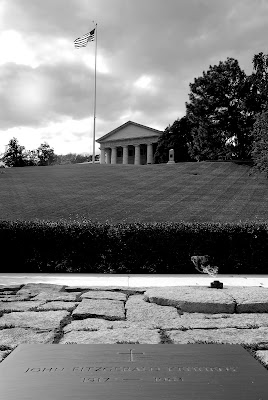 |
| (Photo by someone other than me) |
So my first-ever trip to the nation’s capital was essentially undocumented. There would be no photographs of Kennedy’s grave at Arlington, where I stood with strangers beneath dripping trees, waiting on the rain.
And no pictures of the Vietnam memorials. I'd shot two rolls of film, but they’d been in the camera bag and were gone now. Gone, like the soldiers whose names appeared on the shiny granite slabs. At the base of the monument I had discovered a letter, open, left by a veteran. My doomed macro lens had focused up close, so a few lines could be read, and I snapped the shutter.
Then I picked the letter up and read it. The writer said he was the only member of his unit to survive a particular engagement with the enemy. He still wondered why. And he told his dead buddies that he would meet them all someday, in hell. I don’t recall whether the document was signed.
•
"When life hands you lemons, make lemonade!" So goes the tired Ann Landersism; it bounced around my brain, along with the word “Nikon,” as I thought about my departed Pentax. I resolved to replace my missing camera with a better machine.
It didn’t take long, either. I had been back in Detroit for about a week, and still hadn’t received all the bills from my visit to Washington, when I walked into a camera store. My intention was to just look around, and sniff out a few prices. But a particular machine caught my eye, a 15-year-old Nikon-F – “A real camera!” the salesman said. And against my better judgment I wrote out a check for the amount due, and left the store with a new camera tucked under my arm.
I raced home to read through the owner’s manual and load up with film, my mind plotting an afternoon photo session. I skimmed through the booklet, gathering just enough for a basic understanding of my new picture-gun. Then it was off to the car for a drive downtown, to open fire on an unsuspecting city.
First stop: the People Mover, a multi-million dollar mass transit system, which at the time had been open for less than a year. I’d ridden the 2.9 mile loop around the downtown area a number of times already; it afforded spectacular views of the city. So I parked my car near the Greektown station, paid my fifty cents, and climbed on board. With scarcely a jolt, the car moved out, humming on its electric track.
The photography was actually pretty simple. Shots seemed to frame themselves, as vintage 19th century buildings came in and out of view. Detroit suffers from a dreadful national image, due to crime, mismanagement, graft, and general urban decay. But from an average height of thirty or so feet, it is downright beautiful.
A man who appeared to be a professional photographer boarded the train, loaded down with photo gadgets and accessories. A big photo bag was slung over one shoulder, a couple of cameras were around his neck, and an assistant lugged a tripod and other gear. All I had was a ratty old camera bag, pressed back into active duty, and my new, used Nikon with its crummy little 50mm lens. I felt a bit intimidated, and was glad when this photographer and his second banana got off the train.
Soon I got off as well, having completed one full circuit on the People Mover system. The safety of my new camera was very much on my mind. I made sure it was tucked securely into its bag. But what if I had left it on the train? What if it had become the second of my cameras lost to mass transit, I mused, in a scant two weeks? The irony would have been too great, and I would surely have flung myself headlong from the platform to the ground below, breaking my head open at last, and spilling its absurd contents onto the sidewalk. Passersby would be horrified at the gory sight; a dog would sniff curiously at the ooze seeping from my shattered skull, and perhaps take a tentative nibble.
None of that came to pass. I shot off a few more frames in the downtown area, and eventually headed uptown toward home.
I stopped off in the city’s cultural center, thinking I would take a few pictures of statues in front of the Detroit Institute of Arts. Instead I went into the public library across the street and checked out a book, John Hammond On Record, and then went back outside, where I took a snap of Copernicus, a bust of the Polish mathematician.


