Last April I made a post here called Kennedy Assassination Jokes, a whimsical item recounting the lighter side of assassination criticism.
It has since occurred to me that I left out one of my favorite examples.
Renatus Hartogs was a New York shrink who examined Lee Harvey Oswald in the early 1950s, when Oswald was a truant teenager. Though a decade had elapsed, this was good enough for the Warren Commission to call Hartogs as an expert witness. Hartogs dutifully told the Commission that the teenage Oswald was "dangerous," even though his contemporaneous report did not say that.
Cashing in on his Commission appearance, Hartogs co-authored a book about Oswald called The Two Assassins. With great psychological insight, Hartogs said that the letters in Oswald's pseudonym, Alek J. Hidell, could almost be re-arranged to form "Jekyll-Hyde." (The pseudonym lacked two instances of the letter y.)
In a published review of The Two Assassins, Sylvia Meagher noted that the letters in the name "Renatus Hartogs" could themselves be re-arranged to these phrases: "Trash outrages," and "Strange Authors."
Meagher dreamed up a third anagram, "Thor's Great Anus." Her editor deleted it.
Wednesday, July 27, 2011
Tuesday, July 26, 2011
For Sale (An Unapologetic Rant)
Ever get the sense we are overwhelmed by advertising?
You probably do, because we are. But I think a lot of people are totally accustomed to advertising – so much so that they consider it the norm.
What's not for sale anymore?
I'm especially bothered by the placement of ads, and its non-stop intrusion into our lives. The fact that advertising is at best misleading but most often a lie is, for the purposes of this rant, beside the point.
The placement of ads began to really bother me some years back when I noticed some on the inside front of shopping carts. Anymore, they are positioned wherever you might innocently cast your eyes, or devote a few moments of your attention. Marketing people research the hell out of this and constantly dream up new schemes.
There is nothing these bastards will not stoop to.
You can't even watch a lousy stinkin' baseball game on the tube without advertising intruding at the most unlikely times. All that is required is the thinnest of pretexts. Current examples: a team's manager might visit the mound to make a pitching change. This becomes a "Sprint call to the bullpen!" complete with corporate logo. A pizza company might underwrite a re-cap of the game's key scoring – the "delivery of the game."
It's nauseating. These media sluts will use any opportunity to infect your brain.
"Advertising exists only to purvey what people don’t need," wrote Jerry Mander, in Four Arguments for the Elimination of Television. "Whatever people do need they will find without advertising, if it is available. This is so obvious and simple that it continues to stagger my mind that the ad industry has succeeded in muddying the point."
![]() |
| Kinder and gentler? Nope – just its infancy. |
Thursday, July 14, 2011
The Heidelberg Project: July 2011
Earlier this year, I posted some text and photos of The Heidelberg Project, a remarkable outdoor art environment in Detroit. The black and whites in that post were more than twenty years old, and were taken during what at the time was my one-and-only visit there.
I got back to the Heidelberg Project recently. The art on display has changed since my first visit. Some of the original houses have been razed. But the concept remains the same.
As I said in my original post, the Heidelberg Project is one of those things that must be seen to be believed. I have some new photos, but my pictures, new and old, do not do it justice.
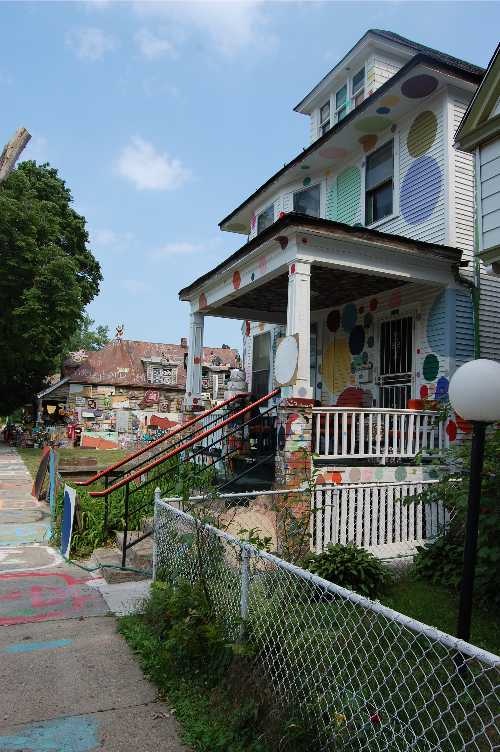
I went back to the Heidelberg Project with my daughter in early July, 2011. We arrived at its west end, at the corner of Heidelberg and Ellery streets. The sidewalk in the photo at left runs parallel to Heidelberg Street.
(By the way, do not consider this post a history of the Heidelberg Project. Not much research involved. As I understand it, though, it originally involved just a few houses. It has since sprawled onto a couple of adjoining streets, although most of it remains here, on Heidelberg.)
One of the project's motifs is multi-colored dots. According to brochures available at the site, artist Guyton "got the idea that people were like jellybeans – all similar, yet different – all the colors together. Well, those jellybeans inspired a dot here, and a dot there, a dotty-wotty house and a polka-dot street, a celebration of color, diversity, and harmony."

Ain't it the truth.
In its largest context, I think you can make a case for Detroit being a sort of poster child for urban blight and decay. Starting in the late 1950s and the 1960s, the powers-that-be dumped billions of dollars into the American war machine, at the expense of domestic programs. But that's another topic for another time.
Check out the Heidelberg Project web site.
I got back to the Heidelberg Project recently. The art on display has changed since my first visit. Some of the original houses have been razed. But the concept remains the same.
As I said in my original post, the Heidelberg Project is one of those things that must be seen to be believed. I have some new photos, but my pictures, new and old, do not do it justice.
Briefly: the Heidelberg Project began in the mid-1980s and is the creation of Tyree Guyton. It is usually characterized as a protest against the decline of a once-great American city, which has fallen victim to the worst sort of neglect.
This sign at the east end of the project serves a dual purpose. It's both a welcome and copyright notice. It's okay to take pictures without permission, its fine print says, provided they are not used commercially.
I went back to the Heidelberg Project with my daughter in early July, 2011. We arrived at its west end, at the corner of Heidelberg and Ellery streets. The sidewalk in the photo at left runs parallel to Heidelberg Street.
(By the way, do not consider this post a history of the Heidelberg Project. Not much research involved. As I understand it, though, it originally involved just a few houses. It has since sprawled onto a couple of adjoining streets, although most of it remains here, on Heidelberg.)
One of the project's motifs is multi-colored dots. According to brochures available at the site, artist Guyton "got the idea that people were like jellybeans – all similar, yet different – all the colors together. Well, those jellybeans inspired a dot here, and a dot there, a dotty-wotty house and a polka-dot street, a celebration of color, diversity, and harmony."
Ain't it the truth.
In its largest context, I think you can make a case for Detroit being a sort of poster child for urban blight and decay. Starting in the late 1950s and the 1960s, the powers-that-be dumped billions of dollars into the American war machine, at the expense of domestic programs. But that's another topic for another time.
Subscribe to:
Posts (Atom)